Turning an enquiry into a student and an application
How the Education pack turns an enquiry into a student record and an application in one step, what starts at that moment, and who checks what.
By Achekam · · 4 min read · For Education businesses in South Africa, Nigeria, Kenya
Launching soon. The Industry CRM add-on described in this article is launching soon. This article describes it as it will work at launch.
Every admissions office knows the gap between "interested" and "applying". A parent phones about a Grade 8 place, a school leaver fills in a website form about a diploma course, a working adult asks at an open day about part-time study. Some of them will apply. Many will not. And the ones who do apply often have to repeat everything they already told you, because the enquiry lived in one place and the application starts somewhere else.
The Education pack in Achekam's Industry CRM closes that gap with a single step: converting the enquiry. This article explains what conversion does, what it sets in motion, and the checks a person should make at that moment.
Enquiries from forms and calls
Before conversion, an enquiry is a lead: a person who has asked about studying with you, with their contact details and what they asked. It may have been typed in by the admissions office after a phone call or a walk-in, or captured from one of your enquiry channels.
Whoever records the enquiry should capture the details that will matter later: the programme or grade asked about, the intake the enquirer has in mind, how they heard of you, and anything they said about fees or funding. Those notes travel with the person if they apply.
Keep enquiries as leads for as long as they are only enquiries. A lead is cheap to hold and easy to follow up, and it does not clutter your list of students with people who never applied. The point of the pack is that the moment an enquirer decides to apply, nothing has to be retyped.
The pack sets the words the screens use for your sector. In the Higher education & EdTech pack, customers are called Students, and the institution keeps Applications, with the documents received, and Enrolments, with a fee plan of instalments.
Conversion creates the student and the application
Converting an enquiry does two things at once. It creates the customer, who becomes a Student, and it creates the industry's main record, which in the Education pack is the Application. Both carry what the enquiry already held.
That single step is the whole value. The applicant's details are entered once; the application is linked to the right student from the start; and the history of the enquiry, every call and note, stays attached to the person who is now applying.
Convert when the enquirer has actually decided to apply, not when they have merely shown interest. A pipeline full of applications that were really just enquiries makes your admissions numbers look healthier than they are.
The intake workflow begins
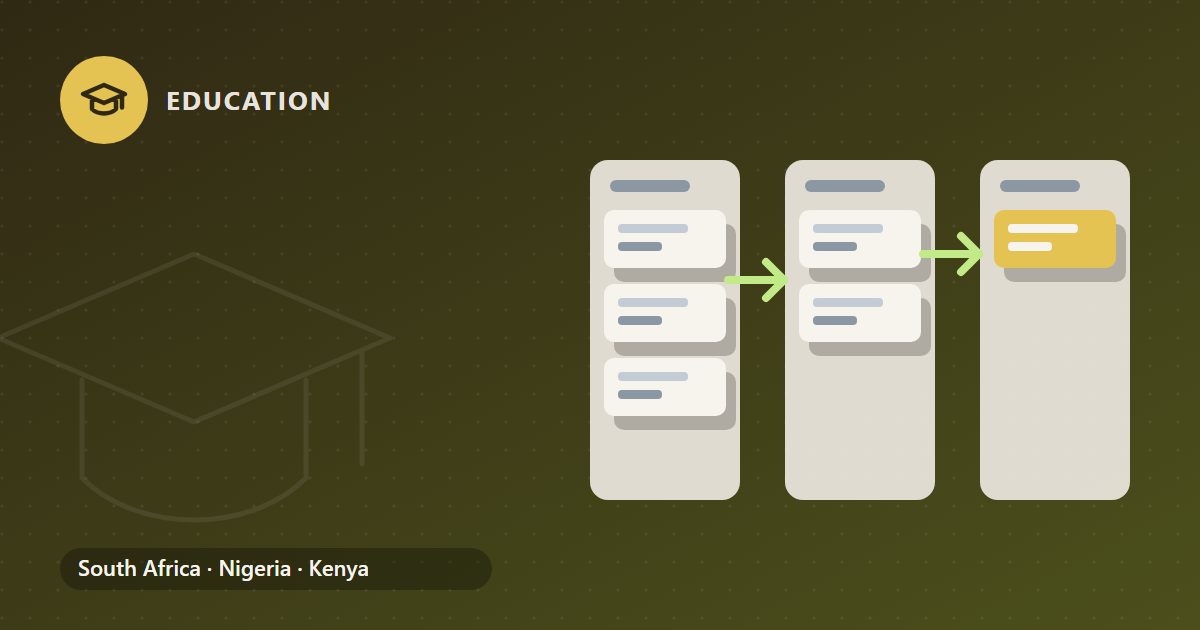
Conversion also starts the application's workflow, and the application enters its pipeline at the first stage. In the Education pack, an application moves from Enquiry to Application received, Documents complete, Assessed, Offer made and Offer accepted. How each stage works is described in following an application through its stages.
At intake, the workflow:
- routes the application to an admissions officer;
- requests the supporting documents from the applicant;
- logs each document as it arrives.
A workflow step can send the applicant a request for documents, and the applicant's answer moves the task on. So a parent who uploads a birth certificate and the last school report is moving their child's application forward without having to phone anyone.
Some stages cannot be entered until set conditions are met. In the Education pack, an application is accepted only once a signature task is done, so an offer cannot be marked accepted on someone's say-so.
Enquiries that go cold
Not every enquiry converts, and the ones that do not are worth as much attention as the ones that do.
Keep cold enquiries as leads rather than converting them "just in case". An enquirer who asked about a February intake and went quiet may come back for the next one; their lead still holds the conversation. When they do decide to apply, conversion picks up from there.
Review open enquiries at the end of each intake. For each one, the admissions office should either follow up, note why the enquirer did not proceed (fees, distance, a place elsewhere), or close it. Those reasons, gathered over a few intakes, tell you more about your admissions than any count of applications.
Investopedia's guide to customer relationship management describes the sales, service and forecasting processes a CRM covers; for a school, the enquiry list is where those ideas meet admissions.
Who checks what at conversion
Conversion is quick, so the checks around it need to be deliberate. A useful division:
| Moment | Who | What they check |
|---|---|---|
| Before converting | Admissions office | The enquirer has decided to apply; contact details are complete |
| At conversion | Admissions office | No existing student record for this person |
| At intake | Admissions officer | The right documents have been requested |
| At assessment | Admissions officer | Every document logged and read |
| At decision | Admissions head | The decision a person made is approved |
The pack does not score, rank or decide on applicants. Decisions are made by people and approved by the admissions head, which is explained further in admissions decisions made by people. Nor is the pack a student-information or learning-management system: once a student is enrolled, timetables, marks and class lists live elsewhere.
When a business switches the Industry CRM on, it picks one of twenty industries; an institution choosing Education should walk through one real enquiry from first call to conversion before the next intake opens, and agree the table above with the admissions team.
General guidance only, not advice on your own circumstances. Tax and payroll rules change: check the current position with the authority or your adviser.
