Tracking proposals to won, lost or not bid
How the Consulting pack tracks a proposal from Identified through bid review and submission to Won, Lost or Not bid, and what the outcomes teach.
By Achekam · · 4 min read · For Consulting businesses in South Africa, Nigeria, Kenya
Launching soon. The Industry CRM add-on described in this article is launching soon. This article describes it as it will work at launch.
Consultancies spend a surprising amount of time on work they never win. Proposals are written late at night, chased for weeks, and then quietly dropped from the list without anyone writing down what happened. A year on, nobody can say which kinds of work the firm wins, which it loses, and which it should never have bid for in the first place.
Achekam's Consulting pack makes every proposal a record that moves through set stages and finishes with a recorded outcome. Over time, those outcomes become the most useful sales information the firm has.
Proposals and statements of work
The Consulting & professional services pack keeps two kinds of record:
- Proposals, for work the firm is trying to win;
- Statements of work, for work it has won, with deliverables and milestones.
Keeping them apart means the pipeline holds only pursuits, and the delivery list holds only committed work. A partner looking at either sees one thing, not a mixture.
The proposal stages
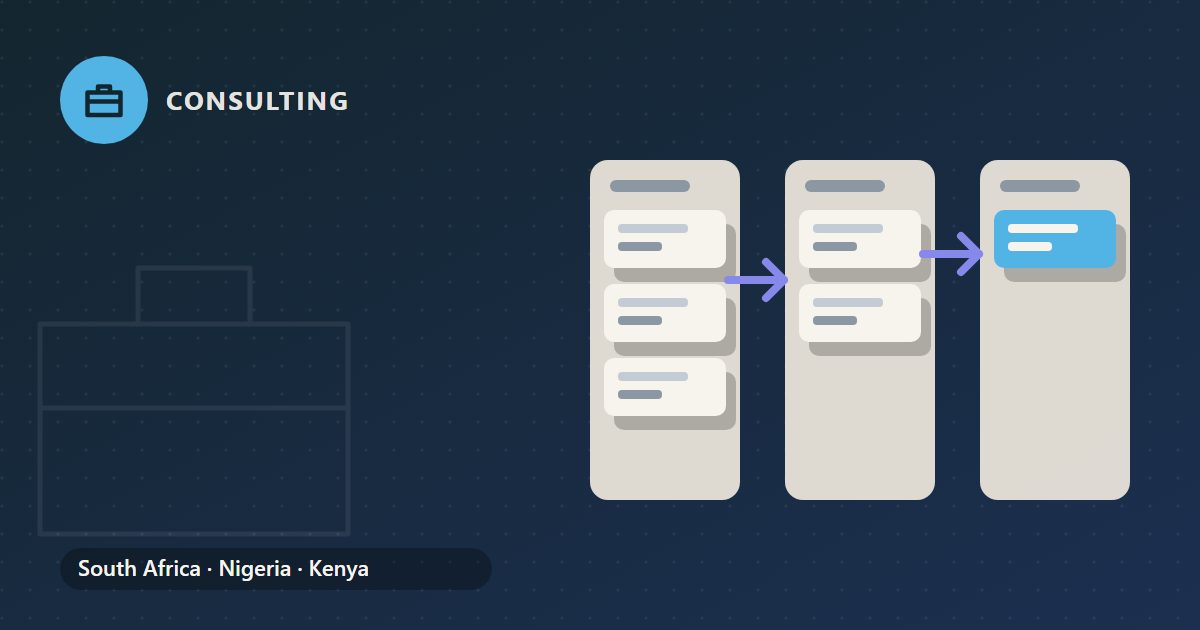
A proposal moves through five stages:
- Identified: an opportunity has been spotted.
- Bid review: the firm decides whether it is worth pursuing.
- Writing the response: the proposal is being prepared.
- Submitted: it has gone to the client.
- Shortlisted: the client has kept it in contention.
It then ends in one of three outcomes: Won, Lost or Not bid.
The stage names describe what is actually happening, which is what makes the board readable at a glance. A partner can see in seconds how many proposals are being written this week and how many are waiting on clients.
Won, lost or not bid
Every proposal should end in one of the three outcomes, and each tells you something different.
- Won: the work moves on to a statement of work.
- Lost: the firm bid and the client chose someone else. Record why, as far as you can find out: price, approach, team, an incumbent's relationship, or no reason given. Ask the client for feedback; many will give it if asked politely and soon.
- Not bid: the firm decided at bid review not to go ahead. That is a decision, not a failure, and recording it is as valuable as recording a win. A firm with no Not bid outcomes is probably bidding for everything.
A win is also a handover. The people who wrote the proposal know what was promised, and the people who will deliver it often do not. Before the proposal is closed as Won, make sure the pricing assumptions, the named team and anything the client was told in meetings are written down where the statement of work will be prepared, so delivery starts from the promises actually made.
The worst outcome is none at all: a proposal left at Submitted for months because nobody closed it. Such records make the pipeline look fuller than it is, and they hide the losses you most need to learn from.
Conditions on moving forward
Some stages carry conditions, and the pack will not move a record into them until those conditions are met. The kinds of condition available include fields that must be filled in, a customer being named, an amount being set, a workflow stage or a whole workflow being done, a particular kind of task being complete, and rows entered on a sub-form.
Conditions like these stop the pipeline filling up with half-records, such as a proposal at Submitted with no client named or no value set. Agree as a firm what must be known before a proposal leaves bid review, and make checking it part of the review itself.
All of this is part of how the pack is shaped for consulting. Each industry pack sets its own words, record types, pipelines, workflows and home-page counts; the Consulting pack sets them around proposals and statements of work.
Reading the outcomes later
The pack's home page shows counts drawn from the records themselves: open records, records in a stage, pipeline value, overdue tasks, tasks due today, key dates in the next 7 days, won this month and revenue this month. None is typed in by hand, so the figures the partners see are the figures the records hold. Investopedia's CRM guide describes what customer relationship management is and the sales, service and forecasting processes it covers.
For a deeper look, review closed proposals every quarter. Group them by type of client, service and size, and look at the outcomes in each group. Patterns appear quickly: a service you nearly always win, a kind of client you rarely win, a size of bid where you keep losing on price, a sector where you bid often and never get shortlisted. Each pattern is a decision waiting to be made about where to spend the next quarter's bidding time.
| Pattern in the outcomes | Question for the partners |
|---|---|
| Many losses in one service | Is it priced or positioned wrongly? |
| Many Not bid in one sector | Should we stop looking there? |
| Long time at Writing the response | Are we starting too late? |
| Wins concentrated in few clients | Are we too dependent on them? |
Habits that keep the pipeline honest
- Enter an opportunity when it is identified, not when writing starts.
- Hold a real bid review and record its decision.
- Close every proposal with one of the three outcomes.
- Write one sentence on why each loss happened.
- Review outcomes with the partners every quarter.
The detail of running a formal response is covered in responding to an RFP before the deadline. What happens after a win, from internal approval to the client's signature, is in signing a statement of work and kicking off.
Enter your live proposals at the stage each has really reached, and close the dead ones with the outcome they deserve. The quarterly review starts from there.
General guidance only, not advice on your own circumstances. Tax and payroll rules change: check the current position with the authority or your adviser.
